
Most hosts never think about tent ballast vs stakes until they measure the yard and find that the only flat spot is the driveway. Then it becomes the whole question, because a tent is only as safe as what holds it down. There are two ways to do that: stakes go into the ground, and ballast sits on top of it. Which one your event gets is decided by the surface, and the surface also decides which tent styles you can rent at all.
This guide covers how each method works, how many stakes or blocks each tent size takes, which surfaces allow which, and what changes on your order when a tent is weighted instead of staked. The counts come straight from our own equipment specs, not from a rule of thumb. It applies to any host: a backyard birthday, a graduation party, a company picnic on a parking lot, or a church festival on the blacktop.
📋 In This Guide
- Tent Ballast vs Stakes: The Short Answer
- How Staking Works, and What It Asks of Your Yard
- How Ballast Works When the Ground Is Pavement
- Tent Ballast vs Stakes by Size: The Counts
- Which Method Fits Your Surface
- What Ballast Changes on Your Order
- The Wind Rules Are the Same Either Way
- Frequently Asked Questions
Tent Ballast vs Stakes: The Short Answer
Stakes are the default and ballast is the substitute, so on grass we stake every tent we install, pole tents and frame tents alike. On asphalt, stakes are out, so a frame tent is secured with concrete blocks instead, one block for every stake it would have used. Ballast is not an upgrade you choose from a menu, but simply what holds the tent when the ground cannot take a stake.
The catch is that only one family of tents can make the switch, and that is the frame tent, which stands on its own metal frame and keeps its shape whether its legs are staked or weighted. A pole tent is a tension structure, and the stakes are part of what keeps it standing, which is why a pole tent belongs on grass. Our pole tent versus frame tent guide compares the two styles in full, so this article stays on the anchoring.
How Staking Works, and What It Asks of Your Yard
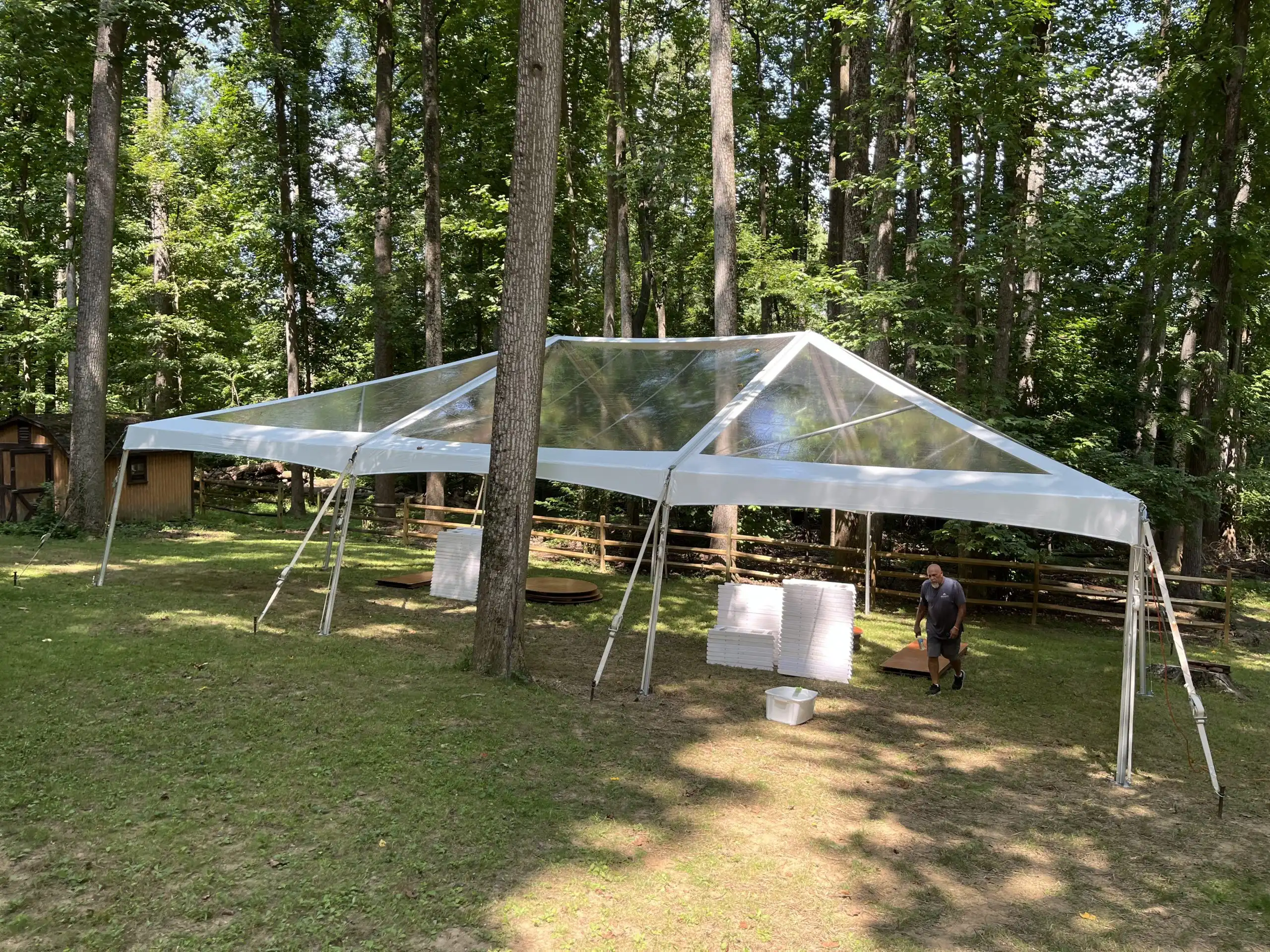
We stake tents with 42 inch stakes driven into grass or dirt around the outside of the tent, and a pole tent needs a lot of them because its stakes do structural work. Our 20 x 20 pole tent takes 12 stakes, a 40 x 60 takes 24, and a 40 x 100 takes 32.
Staking asks two things of the site, and the first is room. Stakes sit outside the tent, so a pole tent adds 10 feet to both its width and its length: a 20 x 20 needs a 30 x 30 space, and a 40 x 60 needs 50 x 70. A staked frame tent needs less, about 5 feet more each way. Our rental agreement asks for 5 to 7 feet of cleared space beyond the tent’s width and length as the minimum.
The second is a clear underground, since anything driven into the ground can hit a buried line. In Maryland that means contacting Miss Utility before install day. The service is free, the request has to go in at least three business days ahead, and it applies no matter how shallow the digging is. Our rental agreement makes that call the renter’s job, and it states that we are not responsible for damage from a buried line.

How Ballast Works When the Ground Is Pavement
When a tent stands on asphalt, a parking lot, or a driveway, we secure it with concrete blocks, which we stock in three weights: 250, 350, and 500 pounds. The 500 pound block is about 20 inches square and 16.5 inches tall, so it is smaller than most people picture and far heavier than it looks.
The count is simple, because every frame tent we rent takes one block per leg, the same number as the stakes it would use on grass. Our 20 x 20 high peak frame tent has four legs and takes four blocks, while a 40 x 60 frame tent has 10 legs and takes 10. Which weight goes on which tent is our call, based on the tent and the site, and it is not something you need to work out.
The industry treats that call as a calculation and not a guess. The Advanced Textiles Association’s tent rental division publishes a ballasting tool that works out the required weight from the surface type, the ballast type, and the condition of the surface, among other factors. We ballast with concrete only, and our catalog has no water barrels or sandbags, because a concrete block does not leak and weighs the same at the end of the night as it did at the start.

Tent Ballast vs Stakes by Size: The Counts
Here is what each method takes across the sizes we rent most. The pole tent column is stakes only, while the frame tent column is stakes on grass or the same number of concrete blocks on asphalt.
| Tent size | Pole tent: stakes | Frame tent: stakes or blocks |
|---|---|---|
| 20 x 20 | 12 | 4 to 8 |
| 20 x 30 | 14 | 6 to 10 |
| 20 x 40 | 16 | 6 to 12 |
| 30 x 30 | 20 | 8 |
| 30 x 45 | 24 | 10 |
| 30 x 60 | 28 | 12 |
| 40 x 40 | 20 | 8 |
| 40 x 60 | 24 | 10 |
| 40 x 80 | 28 | 12 |
| 40 x 100 | 32 | 14 |
The ranges on the 20 foot wide tents come from the frame style. Our high peak frame tents have fewer legs, so they take fewer anchors: four on a 20 x 20, against eight on our other frame styles.
Two things stand out in that table. From the 30 x 30 up, a pole tent needs more than twice the anchors of a frame tent the same size, which is fine in an open field and impossible on a patio. And the block count on a big tent is smaller than most people expect: a 40 x 80 frame tent, which is 3,200 square feet of cover, stands on 12 blocks.
Which Method Fits Your Surface
Grass or dirt
Grass takes stakes, for every tent style, and it is the only surface where a pole tent is a normal option. The pole tent is also the more cost effective style, so a lawn gives you the most choices, provided the utility lines are marked before anything is driven.
Asphalt: driveways, parking lots, blacktop
Asphalt takes concrete blocks under a frame tent, with one exception worth knowing about. A pole tent can go on asphalt only by driving its stakes through the pavement and filling the holes with asphalt plugs afterward, and only with the property owner’s permission. We treat that as an exception for a site that truly needs it, not as a plan for your driveway.
Concrete and patios
Concrete takes a frame tent on weights, and a pole tent cannot go on it at all. A patio works when the tent’s dimensions fit it, legs included, so measure the slab itself and not just the area you want covered.
A site that is part lawn and part pavement points to a frame tent, since it is the one style that works on both. Tell us where the edge falls and we will work out the anchoring from there.
What Ballast Changes on Your Order
Choosing a paved site changes three things on the order, and none of them is hidden.
The tent style. A hard surface means a frame tent, and a frame tent sits in a higher price tier than a pole tent of the same size.
The blocks themselves. Stakes are part of the tent and never show up as a line of their own. Concrete blocks are rented per block, so a 40 x 60 on asphalt adds 10 of them to the order, and the heavier blocks cost more than the lighter ones.
The paperwork, if a permit is involved. Baltimore City requires a permit from its housing department and the Fire Department for any tent over 400 square feet, and the application must document how the tent will be secured to the ground. Staked or weighted, the anchoring method goes on the form. Permits are the renter’s responsibility under our agreement, and our Maryland tent permit guide covers the rest of the state.
What does not change is the install, because our crew installs every tent, staked or weighted, and that is included with the tent. If you are not sure what your site can take, request a quote and describe the surface, ideally with a photo of the spot.
The Wind Rules Are the Same Either Way
Neither method buys extra wind tolerance, and our rental agreement sets one rule for every tent: guests leave the tent when winds exceed 25 mph, or at any point the tent becomes unsecured. Sidewalls come off in high gusty winds, because a walled tent catches wind like a sail.
One more clause matters more with ballast than with stakes: every installation is final, and the tent is not to be moved, altered, or modified once our crew is done. A stake is hard to move by accident, but a block sits at the edge of the tent, right where a delivery or a parked car may want it out of the way. Leave it where it is, because a block that has been shifted is no longer holding what it was placed to hold.
A paved site also suits a cold season tent, when the lawn may be frozen or soaked. Our guide to how late in the year you can have a tent event covers that side of it.
Frequently Asked Questions
Can you put a tent on concrete or asphalt?
Yes, if it is a frame tent. We install frame tents on asphalt, driveways, and patios and secure them with concrete blocks instead of stakes, while a pole tent cannot go on concrete and can go on asphalt only with permission to stake through the pavement and plug the holes afterward.
How much weight do you need to hold down a tent?
It depends on the tent, the surface, and the type of ballast, which is why installers calculate it. On our frame tents the answer is one concrete block per leg, in 250, 350, or 500 pound weights, so a 20 x 20 high peak frame tent takes four blocks and a 40 x 60 frame tent takes 10.
Do I need to call 811 before staking a tent?
Yes, because in Maryland 811 reaches Miss Utility, and any tent secured with stakes needs the underground lines marked first. The request is free and has to be made at least three business days before the install. Under our rental agreement the renter makes that call, while a frame tent on concrete blocks puts nothing in the ground.
Is tent ballast more expensive than stakes?
Yes, in most cases, and for two reasons: stakes come with the tent while concrete blocks are rented per block, and a hard surface calls for a frame tent, which sits in a higher price tier than a pole tent of the same size. The exact figure depends on the tent size and the number of blocks, so ask for a quote and name the surface.
Not Sure What Your Site Can Hold? Tell Us the Surface
Send us the date, the guest count, and what the tent will stand on: lawn, driveway, parking lot, or patio. We will tell you which tent styles fit, how the tent will be anchored, and how many stakes or blocks that takes. Get a quote here, or browse our tent inventory.