
You’ve decided you want an outdoor wedding. You’ve imagined it a hundred times — twinkling lights overhead, your guests gathered under something stunning, the night air coming through the sides. What you haven’t decided yet is which tent is actually going to create the atmosphere you’re after. Two styles consistently rise to the top for Maryland couples who want something that feels like more than just shelter: the sailcloth pole tent and the clear top frame tent. Both are breathtaking. Both photograph beautifully. And they create completely different experiences — which means the right choice depends entirely on your vision, your property, and your priorities. This guide breaks down the sailcloth tent vs. clear top tent comparison from every angle that matters for a wedding.
📋 In This Guide
The Atmosphere Each Tent Creates
Before getting into specs and logistics, start here — because atmosphere is what separates these two tents more than anything else.
A sailcloth pole tent creates warmth. The fabric is translucent — not clear, but softly luminous — and at night it glows from within like a lantern. Guests walk in and the word that comes up over and over is magical. The natural wood poles, the gentle curve of the roofline, the small white flags catching a breeze — it reads as romantic, organic, and unmistakably elegant. If you’ve seen photos of tent weddings that made you stop scrolling, there’s a good chance you were looking at a sailcloth tent.
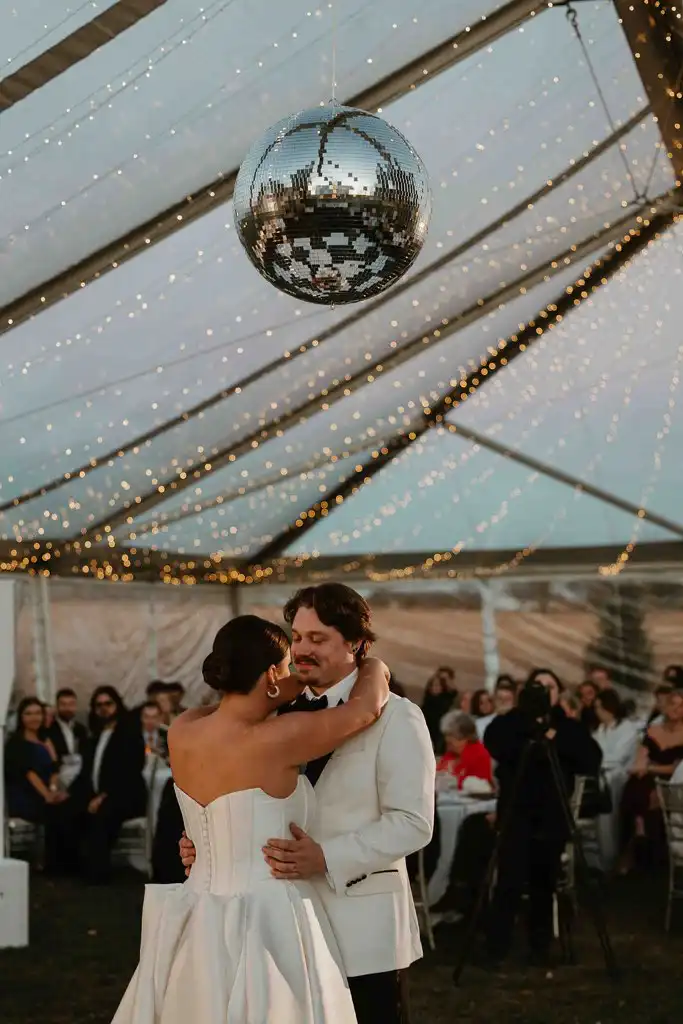
A clear top frame tent creates drama. The roof is transparent vinyl, and what that means in practice is that the sky becomes part of your wedding. During a summer reception, golden hour light pours through. At night, the stars are overhead during your first dance. When it rains, you get the visual spectacle of watching it fall without feeling a drop. The atmosphere is modern, sleek, and cinematic — a totally different aesthetic than the sailcloth, but every bit as stunning.
Neither is objectively better. They serve different visions. The sailcloth is warm and romantic; the clear top is dramatic and contemporary. Choose based on which one matches what you see when you close your eyes and imagine your wedding.
Design and Visual Character Side by Side
Here’s how the design details of each tent compare — the elements your guests will actually notice and your photographer will capture.
Sailcloth Pole Tent
The sailcloth tent’s defining features are its natural wood stained poles and its translucent Aurora fabric. The oval roofline creates a soft, tent-like silhouette that looks nothing like a commercial event structure. White flags attach to the top of the center poles and move in the breeze, adding a detail that’s nearly impossible to replicate with any other tent style. The entire structure has a handcrafted, artisanal quality — this is a tent that looks like it was designed, not just erected.
The center poles are a design element in themselves. Spaced 20 feet apart, they break the interior into defined zones — you can use them as anchor points for floral installations, drapery, or hanging lanterns. Couples who lean into the organic, romantic aesthetic find the center poles actually enhance the design rather than limiting it.
Clear Top Frame Tent
The clear top frame tent has a completely different visual grammar. The roof is entirely transparent, supported by a structural frame with no center poles — nothing interrupts the sight lines from one end of the tent to the other. The perimeter legs are spaced 20 feet apart, so the sides of the tent feel open and architectural rather than cramped.
The clean, modern lines of the Jumbo-Trac engineered frame system have a different kind of elegance — less rustic, more intentional. Couples who choose this tent often add interior drapery, chandeliers, or floral ceiling installations, and the structural system makes it easy to hang and mount décor directly to the tent. The result can be extraordinarily dramatic.
| Feature | Sailcloth Pole Tent | Clear Top Frame Tent |
|---|---|---|
| Roof Material | Translucent Aurora vinyl (warm glow) | Transparent clear vinyl (see-through) |
| Structural Poles | Natural wood center poles + perimeter legs | No center poles — fully open floor plan |
| Roofline Shape | Oval, rounded ends | Rectangular, clean geometric lines |
| Peak Height | 22 feet | 18 feet |
| Perimeter Height | 8 feet | 8 feet |
| Overall Aesthetic | Romantic, organic, warm | Modern, dramatic, architectural |
| Night Look | Warm glow from fabric luminosity | Stars visible overhead |
Surface Requirements and Property Fit
This is where the comparison becomes practical — and for some couples, it becomes the deciding factor entirely.
Sailcloth: Grass First, Asphalt Possible
The sailcloth pole tent is primarily a grass tent. It uses stakes driven into the ground to create the tension that gives the fabric its characteristic shape. That said, installation on asphalt is possible — it requires staking into the asphalt surface and then filling the stake holes with asphalt plugs afterward. If your property has a lawn with adequate clear space, the sailcloth tent is a natural fit. If you’re working with a primarily paved venue, a frame tent will be significantly easier.
Space matters too. The sailcloth tent requires clearance beyond its footprint for stakes and perimeter tension. A 45×64 sailcloth tent needs approximately a 55×74 foot installation area. A 45×84 needs a 55×94 foot space. Before selecting a sailcloth, measure your available area carefully — or request a site consultation so the DER crew can assess the property directly.
Clear Top Frame Tent: Grass or Asphalt
The clear top frame tent is freestanding — it doesn’t rely on stakes and tension to hold its shape. On grass, it uses ground stakes. On asphalt, concrete blocks secure the perimeter legs. This flexibility means it can go on driveways, patios, parking areas, or anywhere with a reasonably flat surface. A 40×60 clear top frame tent requires approximately a 45×65 foot installation space — more space-efficient relative to its footprint than the sailcloth, because there’s no tension cable system extending outward.
For couples renting properties or working with venue coordinators who need flexibility on surface type, the clear top frame tent consistently has the easier installation conversation. For couples with an open grass lawn and a romantic vision, the sailcloth is often worth the site-specific planning.
Not Sure Which Tent Fits Your Property?
Get a free quote from our team — we serve Maryland, DC, Virginia, and Pennsylvania, and we can help you figure out exactly which tent works for your venue.
Get My Free QuotePractical Differences: Weather, Comfort, and Lighting
Both tent styles are commercial-grade and designed to handle real weather. Here’s how they differ on the details that affect your guests’ comfort and experience.
Sun and Heat
The sailcloth tent’s translucent fabric diffuses direct sunlight rather than blocking it. This creates a beautifully lit interior during the day, but it does allow some solar heat to build up in warm weather. For summer weddings under a sailcloth, plan for fans or a portable cooling unit to keep guests comfortable — both are available as add-ons.
The clear top frame tent’s transparent roof provides no shade at all — full sun passes directly through. This makes the interior genuinely warm during daytime summer events. Cooling is essentially required for any warm-weather clear top event during daylight hours. However, the frame tent’s block-out vinyl sidewalls (when added) do help control heat from the sides. For evening and nighttime events, this is a non-issue — the clear roof at night is pure magic without the heat penalty.
Rain and Protection
Both tents are waterproof and designed to keep guests dry in rain. Neither tent includes sidewalls — those are an add-on rental for either style. For the sailcloth tent, the Aurora clear sidewalls use a weather-sealed keder rail system for maximum protection. For the clear top frame tent, walls use the same kedered track system and can be slid open or closed as conditions change. If your wedding date has any chance of rain or wind, budget for walls regardless of which tent you choose.
Lighting
Both tents come with bistro string lighting included around the perimeter. The sailcloth tent’s translucent fabric interacts with lighting in a unique way — as the sun sets and the bistro lights come on, the entire tent glows from the outside. It’s genuinely distinctive and creates a visual effect no other tent style can replicate. The clear top tent’s lighting effect is more conventional from the outside, but the unobstructed ceiling gives interior lighting designers and photographers a completely open canvas to work with. Chandeliers, drapery, floral canopies — the lack of center poles means nothing limits what you can hang.
Sizing and Capacity
Both tent styles are available in sizes that accommodate weddings from intimate gatherings to large-scale receptions. Here’s how Dreamers Event Rentals’ inventory breaks down for each style.
Sailcloth Pole Tent Sizes
All sailcloth tents are 45 feet wide with varying lengths. The oval design means the interior square footage calculation differs from a rectangular tent of the same stated dimensions.
| Size | Sq Ft | Seated Rounds (8/table) | Seated Rectangle (8/table) | Standing |
|---|---|---|---|---|
| 45×44 | ~1,980 sq ft | 112 guests | 176 guests | 120–200 |
| 45×64 | ~2,880 sq ft | 176 guests | 296 guests | 200–300 |
| 45×84 | ~2,969 sq ft | 240 guests | 416 guests | 250–450 |
| 45×104 | ~4,680 sq ft | 304 guests | 536 guests | 450–550 |
Clear Top Frame Tent Sizes
Clear top frame tents are available in 40-foot-wide configurations. The rectangular footprint makes capacity planning more straightforward.
| Size | Sq Ft | Seated Rounds (8/table) | Seated Rectangle (8/table) | Standing |
|---|---|---|---|---|
| 40×60 | 2,400 sq ft | 192 guests | 288 guests | 300–350 |
| 40×80 | 3,200 sq ft | 256 guests | 384 guests | 380–400 |
| 40×100 | 4,000 sq ft | 320 guests | 480 guests | 500–600 |
For a full breakdown of how to match tent size to your specific guest count — accounting for dance floors, bars, buffet lines, and staging — see our guide to how to size a tent for an event. And to browse the full tent inventory by size, you can view every option on our site.
Pricing Comparison
Pricing for both tent styles reflects tent rental only — delivery, installation, and perimeter bistro lighting are included. Add-ons like sidewalls, interior lighting, dance floors, heating, and cooling are priced separately.
| Tent | Size | Price |
|---|---|---|
| Sailcloth Pole Tent | 45×44 | $2,997 |
| Sailcloth Pole Tent | 45×64 | $3,997 |
| Sailcloth Pole Tent | 45×84 | $4,997 |
| Sailcloth Pole Tent | 45×104 | $5,997 |
| Clear Top Frame Tent | 40×60 | $3,550 |
For the full picture of what goes into wedding tent pricing — including all the add-ons that affect your total — see our complete breakdown of how much a wedding tent rental costs in Maryland. You can also review the most common wedding tent rental questions to understand exactly what is and isn’t included in every rental.
Which Tent Is Right for Your Wedding?
Here’s the honest summary of the sailcloth tent vs. clear top tent decision:
Choose the Sailcloth Tent If:
- You want a warm, romantic, organic atmosphere — the “enchanted evening” feel
- Your venue is on grass (or you’re prepared for asphalt installation specifics)
- You love the idea of the tent glowing from within at night
- You want a distinctive silhouette that looks nothing like a standard event tent
- You’re comfortable working with center poles as part of the design
Choose the Clear Top Frame Tent If:
- You want a modern, dramatic look with the sky as part of the experience
- Your venue is on asphalt, a driveway, or a patio
- You want a completely open ceiling for drapery, lighting installations, or chandeliers
- You’re planning an evening or nighttime event (stargazing during the first dance)
- You need maximum flexibility in interior layout without center poles
Both styles are available from Dreamers Event Rentals and have been installed at weddings across Carroll, Baltimore, Frederick, Howard, and Anne Arundel counties. If you’re still deciding — or if you want to discuss how either tent would work on your specific property — our team is available to talk through the details at no obligation. Request a free quote and let us help you figure out which option is right for your event.

Frequently Asked Questions
Can a sailcloth tent vs. clear top tent be installed on any surface?
The sailcloth pole tent is primarily designed for grass. It can be installed on asphalt, but requires staking into the surface and patching the holes afterward — something to factor into your venue conversation. The clear top frame tent is fully freestanding and can be installed on grass or asphalt with equal ease, using stakes or concrete blocks depending on the surface. If your venue is primarily paved, the clear top frame tent will be the simpler option.
Are sidewalls included with a sailcloth tent or clear top tent rental?
No — sidewalls are an add-on rental for both tent styles. They are not included in the base tent price. For sailcloth tents, the compatible sidewalls are the Aurora clear walls that use a weather-sealed keder rail. For clear top frame tents, sidewalls use the kedered track system and can slide open or closed. If there’s any chance of rain or wind on your wedding date, we strongly recommend adding walls to your order.
Is a sailcloth tent hotter than a clear top tent in summer?
Both can get warm in summer sun, but for different reasons. The sailcloth fabric diffuses rather than blocks sunlight, allowing some solar heat gain while creating a soft, glowing interior. The clear top tent’s transparent roof allows full sunlight through, making cooling essentially necessary for daytime summer events. For either tent style, Dreamers offers fans and portable cooling units as add-on rentals. For evening and nighttime events, this is much less of a concern with either option.
How far in advance should I book a sailcloth or clear top tent in Maryland?
For peak wedding season in Maryland — May through October — booking 6 to 12 months in advance is strongly recommended for either tent style, particularly sailcloth tents, which have limited inventory. A quote alone does not hold your date or inventory. Only a signed rental agreement and deposit secures your reservation. If your date is approaching and you haven’t booked yet, reach out to check availability — our team can often accommodate shorter timelines depending on the season.