
How to light a tent at night comes down to three questions most hosts never ask out loud: when does it actually get dark, which light does which job, and what happens to the space outside the canopy once the sun is gone. Get those right and a tent glows invitingly from the road; get them wrong and the guests at the far table eat in shadow while the route to the parking area becomes a guessing game.
This guide is for anyone running an event past sunset: a backyard birthday, a graduation party, a company cookout, a reunion, or a fall festival on a school lawn. It compares the lighting we rent side by side, gives you the strand count for every tent size we carry, and walks through the dark spots that regularly catch hosts out. Everything here comes from our own product records and rental agreement, so you can plan with real numbers instead of estimates.
📋 In This Guide
- How to Light a Tent at Night Starts With the Sunset
- Bistro, Globe, String or Chandelier: Which Light Does Which Job
- How Many Strands Your Tent Needs
- How to Light a Tent at Night Beyond the Canopy
- Bright for Dinner, Low for Dancing: Why a Dimmer Earns Its Place
- Power and Cords for Tent Lights
- Frequently Asked Questions
How to Light a Tent at Night Starts With the Sunset
The sunset determines how much of your event needs artificial light, and in Maryland it moves dramatically across the year. In late June the sun sets around 8:36 PM in Baltimore, so a party running from four to nine barely needs a bulb, but by October 1 sunset arrives near 6:50 PM, and by Halloween it is close to 6:07 PM.
Then the clocks change, and on November 1 the sun goes down around 5:06 PM before settling near 4:43 PM in early December, the earliest sunset of the year. A fall party that starts at four is dark for most of its run, so the lighting you planned as decoration becomes the lighting your guests depend on.
Check your own date with the NOAA Solar Calculator or the U.S. Naval Observatory sun and moon data. Both give sunset and the end of twilight for any location, and you should plan for full darkness about half an hour after sunset. If you are hosting late in the season, our guide on how late in the year you can hold a tent event covers walls, heat and timing too.

Bistro, Globe, String or Chandelier: Which Light Does Which Job
Each type of tent light has one job it does best, and a good plan assigns every fixture to that job. Most people think of lighting as a single decision, but in practice it is a small set of layers, and each layer solves a different problem.
| Light | Job it does best | Where it goes | Price tier |
|---|---|---|---|
| Bistro strands (26 ft and 48 ft) | Even, warm glow across the whole tent | Along the edge of the tent, installed by our crew | Mid-range |
| Ceiling strands | Fills the middle of a wide tent | Run across the top of the tent, a custom add-on per strand | Mid-range, plus install |
| String lighting | Simple accent light | Where you want a lighter touch | Entry-level |
| Globe lighting | A different bulb look from bistro | Ask us where it fits your layout | Mid-range |
| 4-globe chandelier | One focal point | Over a head table, a buffet or the dance floor | Premium |
| Dimmer | Changes the mood without changing the lights | On the lighting circuit | Entry-level |
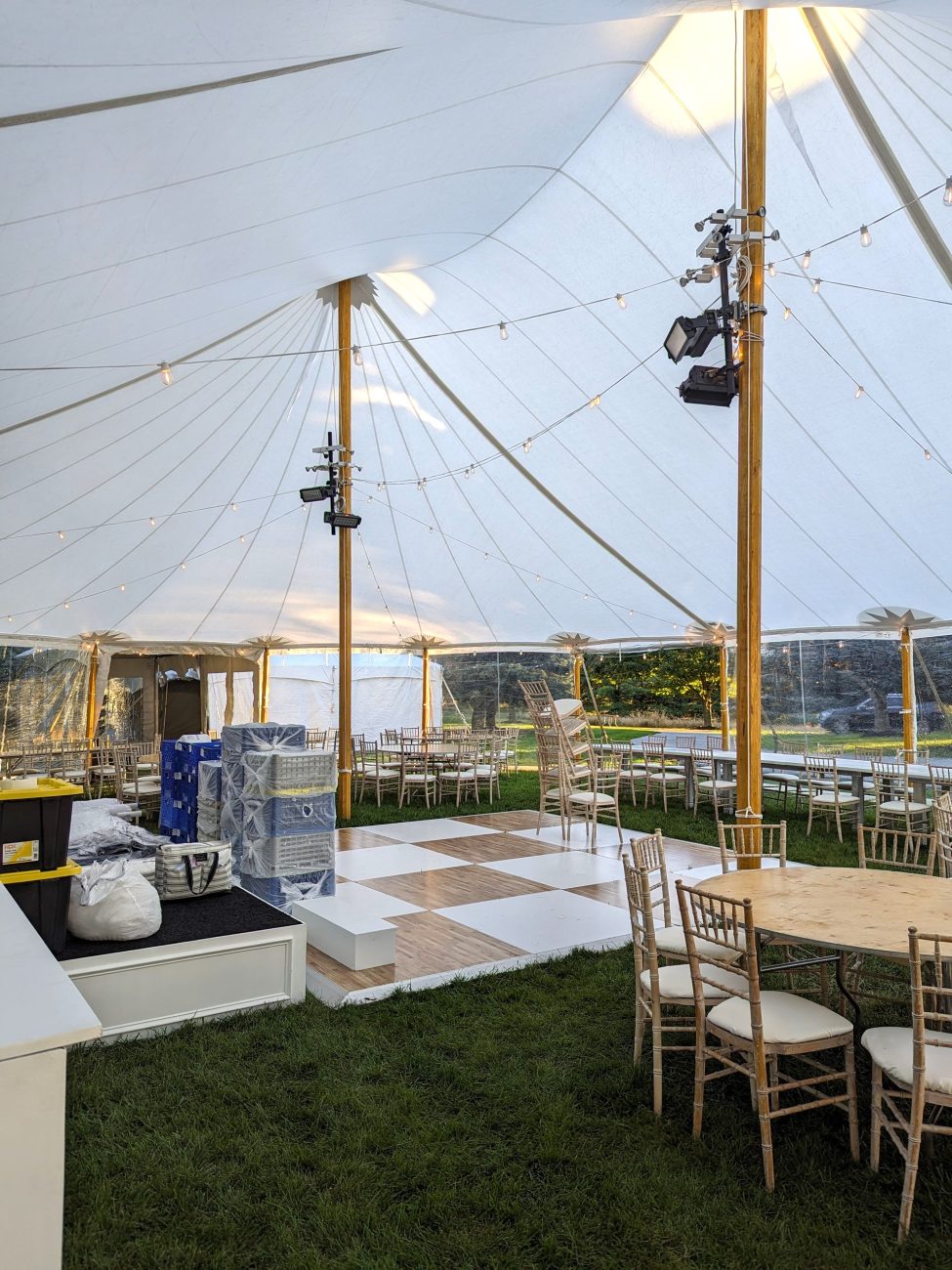
Bistro strands are the backbone. They come in 26 foot and 48 foot lengths, and every tent we rent lists how many 48 foot strands it takes to run its full perimeter. When you rent lights with a tent, our crew installs them as part of the tent setup at no additional cost. Edge installation is the standard, while lighting across the top of the tent is a custom addition priced per strand.
Chandeliers are the premium choice, and you only need one or two. One chandelier over the cake table or the head table pulls every eye in the room, while six of them in a medium tent simply look cluttered. If you want the design side of this, with color and style ideas, our post on tent lighting trends goes deeper.
Which is worth it? For most parties, the perimeter strands do nine tenths of the work. Add ceiling strands when the tent is 40 feet wide or more, because light from the edges fades before it reaches the middle tables, and add a chandelier only if there is one particular spot you want everyone to notice.
How Many Strands Your Tent Needs
Here is the number of 48 foot bistro strands it takes to light the edge of each tent we carry. These counts come directly from our tent records, and they cover the perimeter only, so any ceiling strands are additional.
| Tent size | 48 ft strands for the edge |
|---|---|
| 20×20 and 20×30 | 2 |
| 20×40, 30×30 and 45×44 sailcloth | 3 |
| 20×60, 30×45, 30×60, 40×40, 40×60 and 45×64 sailcloth | 4 |
| 40×80 | 5 |
| 40×100 | 6 |
| 40×120 | 7 |
| 40×140 | 8 |
| 40×160 | 9 |
Two details are worth noticing. A 20×20 and a 20×30 take the same two strands, so stepping up in tent size adds nothing to the perimeter lighting. The wide tents are where ceiling strands matter, because in a 40×60 the middle of the floor sits 20 feet from the nearest edge, which is exactly where a dinner table turns dim. If you are still choosing a size, start with how to size a tent for your event and then light the size you pick.
How to Light a Tent at Night Beyond the Canopy
The tent itself is the easy part, because the dark spots that cause trouble are almost always outside it. Walk the property at the hour your party ends, not the hour it starts, and look for these problem areas.
- The path to the house or the restroom. Guests will make this trip after dark, so turn on every porch and yard light you own and keep cords and stakes away from the walkway.
- Where people park. A field or a side street is completely dark by eight in October, so tell guests exactly where to go before they arrive.
- The food and the bar. Caterers need genuine working light to serve, and so do the people pouring drinks, so put the brightest light where the work happens.
- Steps, slopes and edges. Any change in ground level that guests cross at night needs light on it.
For anything beyond the standard tent lighting, we offer a custom light package: you describe what you want illuminated, and we calculate the plan and the price with you. That is the route for a festival lawn or a long driveway.
A word on candles and torches. Our rental agreement allows no open flames within 20 feet of the tent, which rules out tiki torches by the entrance, fire pits beside the walls, and real candles on the tables. Flameless candles give the same warm look with none of the risk, and the National Fire Protection Association suggests flameless candles too. If you want a fire pit, position it well beyond 20 feet and light the path that leads to it.

Bright for Dinner, Low for Dancing: Why a Dimmer Earns Its Place
Yes, tent lights can be dimmed, and a dimmer is one of the most affordable upgrades on the list. It lets you turn the strands up or down and change the atmosphere of the whole room at once, which matters because an evening event needs different light at different moments.
During dinner, guests want to see their food and each other, so the lights run high, and during speeches a slightly lower setting draws attention to whoever holds the microphone. Once the music starts, low light makes people noticeably more willing to dance. A company awards night follows the same arc as a fortieth birthday, just with a podium instead of a playlist.
Choose one person to control the dimmer and give them the plan, because the lights should come back up for the cake, the final toast and the walk out. Nobody wants to search for a coat or a bag in the dark.
Power and Cords for Tent Lights
Lights need power, and under our rental agreement the renter is responsible for supplying it. Bistro strands plug into a standard outlet and draw very little compared with a heater, but extension cords are not included with our bistro lighting, and the listing for each strand says so. You can add one to your order, so nobody is hunting for a cord at six o’clock on the day of the party.
If there is no outlet near the tent, we rent two quiet generators. The smaller is a 2,000 watt inverter, and the larger supplies 3,000 running watts with two standard outlets and a twist lock connection. Lights alone rarely need the larger unit, although lights combined with a sound system, heaters or a caterer’s warming equipment often do. Our full guide to power for a tent event walks through what each item draws.
One planning tip: keep the lights on a separate circuit from the heaters. If a heater trips a breaker you lose warmth for a minute, but if it takes the lights with it you lose the entire room. You can see our lights, dimmer and generators together on the tent accessories page.
Planning an evening event? Tell us your date, your start and end time, the tent size and where the nearest outlet is. We will match the lights to the space and add up the strands for you. Get a quote.
Frequently Asked Questions
How many lights do I need for a tent?
Most tents need two to four 48 foot bistro strands to light the full perimeter: a 20×20 or 20×30 takes two, a 20×40 takes three, a 40×40 or 40×60 takes four, and the longest tents take up to nine. Tents 40 feet wide or wider usually need ceiling strands as well, because edge light fades before it reaches the center tables.
Do I need a generator for tent lighting?
You need a generator only if there is no outlet you can reach from the tent. Bistro strands plug into a standard outlet, so a backyard party often runs comfortably on household power with the right extension cord. If the tent is in a field or a park, our 2,000 watt or 3,000 running watt generator covers the lights. Tell us what else needs power so we can size it with you.
Can tent lights be dimmed?
Yes. We rent a lighting dimmer that turns the strands up or down together. It lets you run bright for dinner, lower for speeches and low for dancing without touching a single bulb, so add it when you book the lights and it arrives with them.
What time does it get dark in Maryland in the fall?
In Baltimore, sunset falls from about 6:50 PM on October 1 to about 6:07 PM by October 31. After the clocks change in early November it drops to about 5:06 PM, and it bottoms out near 4:43 PM in early December. Expect full dark about half an hour after sunset, and plan your lights for that time.
We have set up tents across the Baltimore area since 2011, and we carry sizes from a 20×20 for a backyard birthday up to a 40×160. We deliver within about 50 miles of Reisterstown, and further for larger events on request. Send us your date and your timeline, and we will build the lighting plan with you. Request your free quote.