
Can you connect two tents together? Yes. Two high peak frame tents of the same 20 foot width can be joined end to end with a gutter that seals the seam, which turns a 20×20 and a 20×40 into one 20×60 run. We rent joined sizes from 20×50 up to 20×80, and the gutter comes with them, but there is one catch: the sides you join have to match in width, and that single rule decides most of what you can and cannot build.
This question usually starts with a yard, a lot or a lawn that will not take one big square tent, because the space is long and narrow, because a tree, a fence or a driveway cuts it in half, or because the guest list grew after the first tent was booked. Whether it is a backyard birthday, an office cookout, a graduation party or a school fair, joining two tents can be the fix, and this guide covers how the join works, which sizes we build this way, and when one wider tent is the smarter call.
📋 In This Guide
- Can You Connect Two Tents Together? The Short Answer
- What Actually Joins Two Tents: The Gutter
- The Joined Sizes We Rent
- When to Connect Two Tents Together, and When Not To
- Two Joined Tents or One Wider Tent?
- Can You Connect Two Tents Together in Your Space? Ground, Room and Permits
- Frequently Asked Questions
Can You Connect Two Tents Together? The Short Answer
Yes, but not any two tents and not in any direction, so here is what holds true for the tents we rent:
- The tents must be the same width. Our gutter attachment fits 20 foot wide high peak frame tents only.
- They join end to end. Two 20 foot wide tents make one longer 20 foot wide tent, and they do not join side by side into a 40 foot wide space.
- The lengths can differ. A 20×20 can join a 20×30 or a 20×40, because only the matching 20 foot edge has to line up.
- The result reads as one tent. Guests walk the full length under cover, with no gap to step through in the rain.
So the real question is rarely whether it can be done, but whether a long, 20 foot wide tent will fit your space and your event better than a wider one, and the rest of this guide helps you answer that.

What Actually Joins Two Tents: The Gutter
Two tents pushed close together are still two tents, and where their edges meet there is a gap. Rain runs off both roofs and pours straight down that gap onto the guests standing under it, which is exactly the problem a gutter solves.
A tent gutter is a long channel that clips along the meeting edge of both tents. It closes the seam and catches the water from both roofs, then sends it out the ends instead of into the middle of your party, and tent makers describe it the same way. German tent manufacturer HTS TENTIQ notes that when two tents are connected, a gutter is installed at the eaves between them to protect against rain.
We stock clip on gutters in two lengths, 20 feet and 40 feet, and the 20 foot gutter is the one built for our 20 foot wide high peak frame tents. You never handle it yourself, because every tent we rent is put up by our own crew, and that includes the join.
One thing a gutter does not do is add walls: the seam is closed overhead, but the sides of the tent stay open unless you add sidewalls, which are a separate rental, so plan for walls on the weather side if the forecast looks wet or windy.
The Joined Sizes We Rent
You do not have to book two tents and a gutter and hope they line up. We list the common joins as their own sizes, each built from two high peak frame tents with the gutter included:
| Joined size | Built from | Space needed to install |
|---|---|---|
| 20×50 | 20×30 + 20×20 | 25 ft x 55 ft |
| 20×60 | 20×40 + 20×20 | 25 ft x 65 ft |
| 20×70 | 20×40 + 20×30 | 25 ft x 75 ft |
| 20×80 | 20×40 + 20×40 | 25 ft x 85 ft |
Look at the last column, because every joined size needs only 25 feet of width to install, and that is the whole appeal. A 20×80 covers 1,600 square feet, the same floor as a 40×40, but the tent itself is half as wide.
On cost, a joined size runs about the same as renting its two halves on their own, and the gutter comes with it rather than as an extra line. A joined 20 foot wide tent is also often less than a 30 foot or 40 foot wide engineered tent of similar floor space. Your exact number depends on the size, your date, the delivery distance and any walls, lights or flooring you add, and the fastest way to see it is to request a free quote.
For a feel of how many guests each half holds, see our guide to how many tables fit in a 20×40 tent, since a 20×80 is simply two of those placed end to end.
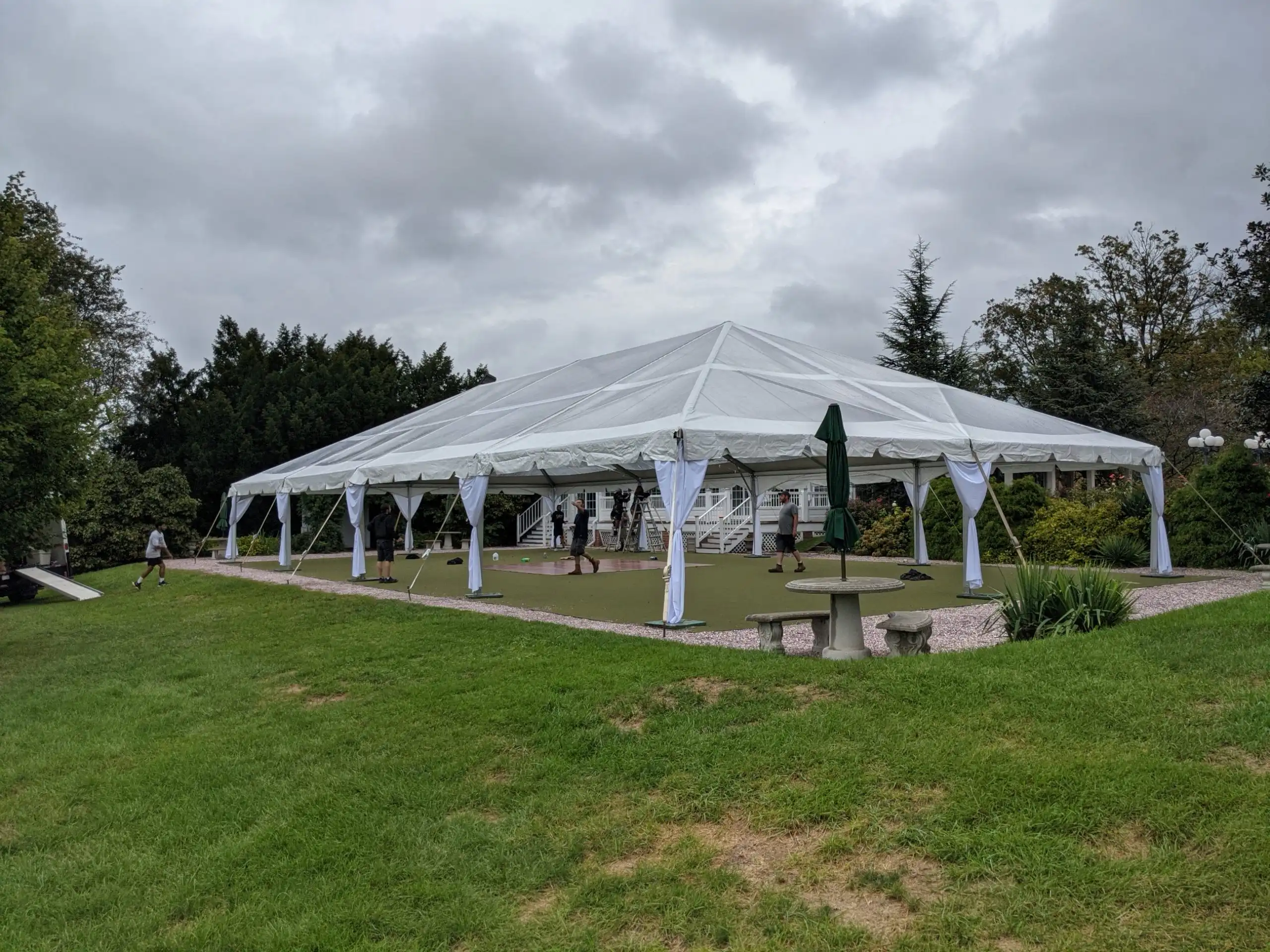
When to Connect Two Tents Together, and When Not To
Joining two tents is the right move in a few clear cases:
- Your space is long and narrow. Think of a side yard, a strip of lawn along a building, or a row of parking spaces, where a 25 foot wide strip cannot take a 40 foot wide tent but can take a 20×80.
- You want zones under one roof. Put food and the bar at one end, seating in the middle and a DJ or games at the other, and a long tent gives each its own space with a natural flow.
- Your guest list grew. If you booked a 20×40 and now need more room, adding a 20×20 or 20×30 to the end can be simpler than starting over with a different tent.
- You need a covered walkway feel. Long tents work well along a building front, beside an entrance or over a line of vendor tables.
Joining is the wrong move when the space is wide open and square, because a very long tent puts guests at the far end a long walk from the food, the speeches and each other. If you have the width, one wider tent usually feels more like one party.
It is also not the answer when you want two tents of different widths to meet. A 20 foot wide tent and a 30 or 40 foot wide tent do not share an edge that a gutter can seal, so we can still set them close together, but they stay two separate tents with a gap between them.
Two Joined Tents or One Wider Tent?
Once you need more than about 1,000 square feet, you have two paths. You can go long with a joined 20 foot wide tent, or go wide with a 30 or 40 foot wide engineered frame tent. Our 40 foot wide frame tents come as single systems in lengths up to 40×120, so they never need a gutter seam at all, and here is how to choose between the two paths:
- Pick joined tents when the space is narrow, when you like the look of a row of high peaks, or when the layout runs in a line.
- Pick one wider tent when the space is open, when you want everyone facing one stage or one head table, or when you need a big dance floor in the middle.
- Pick one wider tent for a large crowd. As a rough guide, about 100 guests fits a 30×45, 30×60 or 40×40, and about 150 fits a 40×60 or 40×80.
If you are not sure which side of the line you are on, our guide on what size tent you need for 100 guests walks through the math.

Can You Connect Two Tents Together in Your Space? Ground, Room and Permits
Measure the full run, plus room around it. A joined tent needs its whole length clear, plus space around the edge for stakes or weights, and we generally ask for 5 to 10 feet of clearance around a tent; the install sizes in the table above already add that buffer.
Check the ground under the whole length. Frame tents can go on grass or on hard surfaces like asphalt, with stakes on grass and weights on a driveway or parking lot. A long tent often crosses more than one surface, so tell us if part of it lands on pavement. Our guide to tent ballast versus stakes explains the difference.
Ask about the permit early. Whether you need a tent permit depends on your county and the size of the tent, and when two tents are joined, plan to give the county the full joined size, since that is what will stand in your yard. We can help guide you, but the permit is often the client’s responsibility. Many fire codes for tents trace back to the NFPA 102 standard for tents and membrane structures, so your local fire marshal is a good first call.
Watch the forecast. A gutter handles normal rain well, but sidewalls make the biggest difference in wind and sideways rain. Check the National Weather Service Baltimore/Washington office in the week before your event, and add walls if storms show up.
Tell Us About Your Space
The fastest way to know whether to join two tents or rent one wider tent is to tell us the size of your space, your guest count and what is going on the ground. Send a photo or a rough sketch if you have one, and we will tell you which tent fits, whether it needs a gutter, and what else to add. Get a free quote and we will build it around your yard, lot or lawn. You can also browse every size on our tent rentals page.
Frequently Asked Questions
Can you connect tents of different sizes?
Yes, as long as the sides you join are the same width. With our gutter, any 20 foot wide high peak frame tent can join another, so a 20×20 can join a 20×30 or a 20×40, but a 20 foot wide tent cannot be sealed to a 30 or 40 foot wide tent, because the edges do not match.
Will joined tents keep the rain out?
Yes, overhead: the gutter closes the seam between the two roofs and carries the water out the ends, and our tent tops are commercial grade vinyl that is water resistant. The sides stay open unless you add sidewalls, so add walls when the forecast calls for wind or heavy rain.
Is it better to join two tents or rent one bigger tent?
It depends on the shape of your space: joined tents win when the space is long and narrow, since even a 20×80 needs only about 25 feet of width. One wider tent wins when the space is open and you want everyone together around one stage, head table or dance floor.
Does joining tents change the permit?
It can, because permit rules depend on your county and the size of the tent, and a joined tent is one larger structure, so give your county the full joined size when you ask. We can help guide you through it, but the permit is often the client’s responsibility.
Have a space that will not take one big tent? Request your free quote and we will tell you exactly what fits.